A hiring plan that
releases itself
A healthcare SaaS company was deciding headcount the way most companies that size do, by argument in a meeting, with the loudest function usually winning. Every planned hire now carries a threshold that has to be measured before the role opens, and the measurement comes off the same close that produces the financials.
What it produces
A close, a board package, and one document that decides what the company is allowed to spend next.
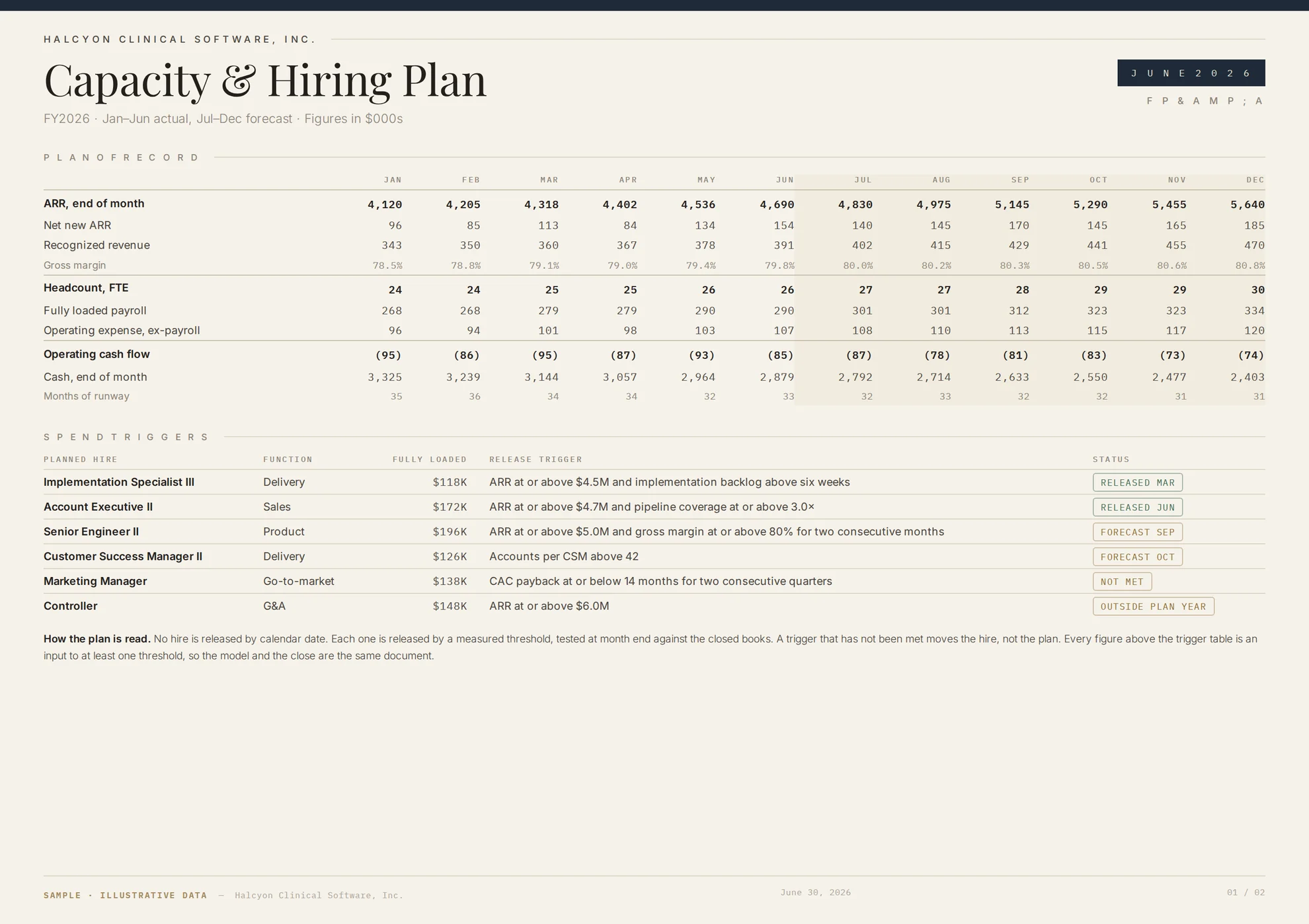
The capacity model carries every role in the plan year with its fully loaded cost and the condition that releases it. Some are revenue thresholds. Some are load measures, like accounts per customer success manager, or weeks of implementation backlog. One waits on two consecutive months at or above a gross margin floor, because hiring engineering into a margin that is still moving is how a good quarter turns into a structural problem.
Nothing in it is aspirational. Each threshold is computed from a figure that appears in the monthly close, so the model updates as a consequence of closing the books rather than as a separate exercise somebody has to remember to run. When a trigger has not been met, the hire moves and the plan holds.
The founder took the argument out of the room. The question stopped being whether the company can afford another engineer and became whether the condition has been met, which is a question with an answer.
What was broken
The books were fine. The decisions were not.
This is the case where nothing is wrong with the accounting. Single entity, clean books, closing on time, a bookkeeper who does the job. That is exactly the company most controller pitches have nothing to say to.
What was missing sat one layer up. Revenue was growing and headcount was growing, and no document connected the two, so every hire was relitigated from scratch against a cash balance that felt either comfortable or alarming depending on the week. The board saw a P&L and asked forward-looking questions the P&L could not answer. Payroll, the largest line in the business, sat undifferentiated by department, so the cost of any given function was a matter of opinion.
The build
Close first. Everything else is downstream of it.
The close came first, on a fixed calendar, because a forecast built on books that land whenever they land inherits that uncertainty and hides it behind decimal places. Labor and payroll tax were then allocated across departments and trued to the general ledger, which made the cost of each function a fact rather than an estimate. That allocation is what the capacity model prices a hire against.
The model itself carries the plan year month by month: ARR and net new ARR, recognized revenue, gross margin, headcount by function, fully loaded payroll, operating expense, operating cash flow, cash, and months of runway on trailing burn. The trigger table sits underneath it, and each trigger reads from a row above it. Nothing in the trigger table can be true without being visible on the same page.
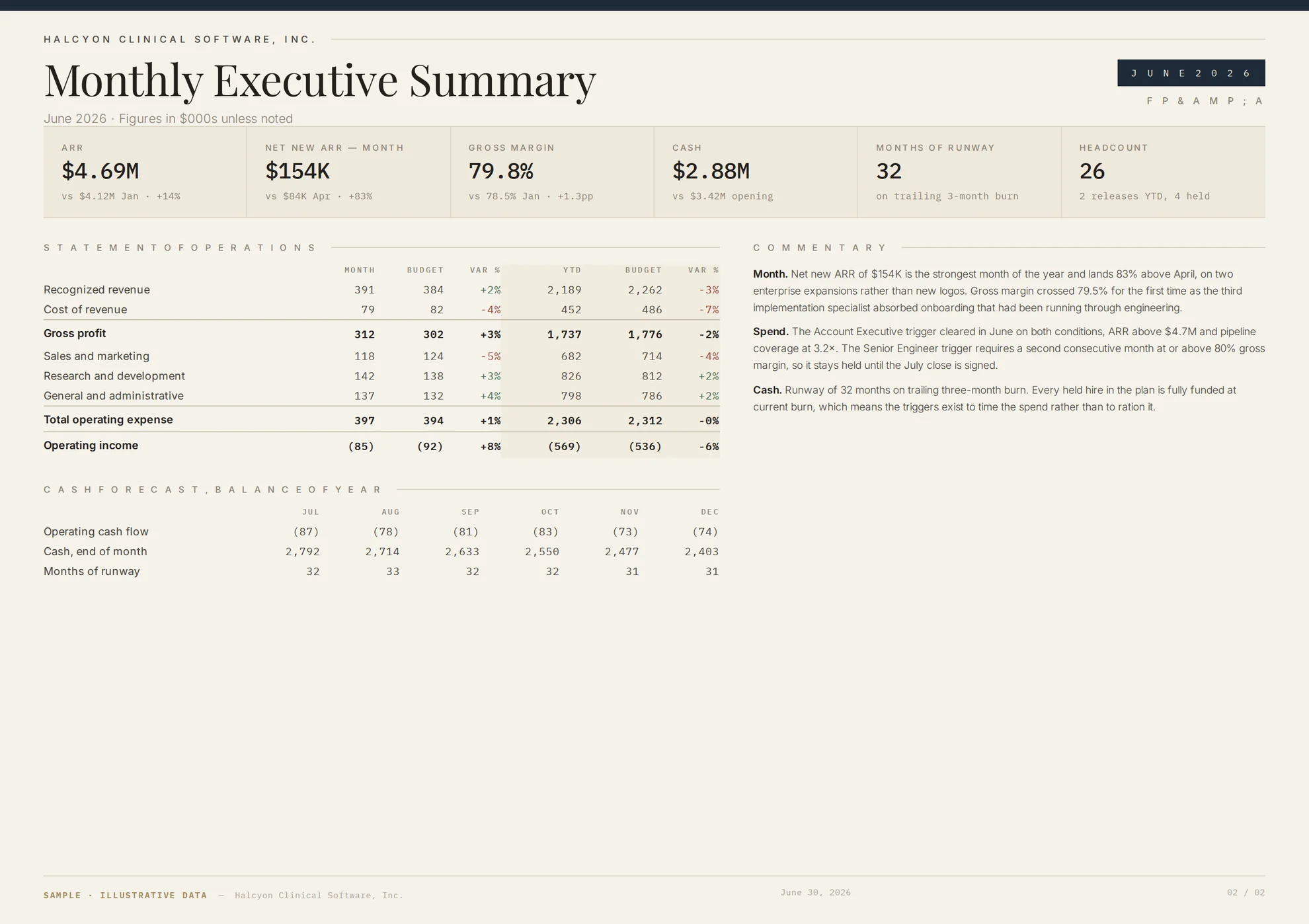
On top of that sit the monthly executive summary and a two-slide board deck. Both are generated from the closed numbers, so the narrative and the statements cannot drift from each other between the close and the meeting.
What it runs today
Every month: close, statements, allocation true-up, executive summary, board deck, and a re-cut of the cash forecast against actual burn. The capacity model is re-scored the same day, and any trigger that cleared or slipped is reported in the summary rather than discovered later.
There is no internal accounting team here and no audit requirement, which makes this the shape a lot of companies between three and fifteen million actually have. They do not need someone to own the ledger. They need someone to own what the ledger is for.